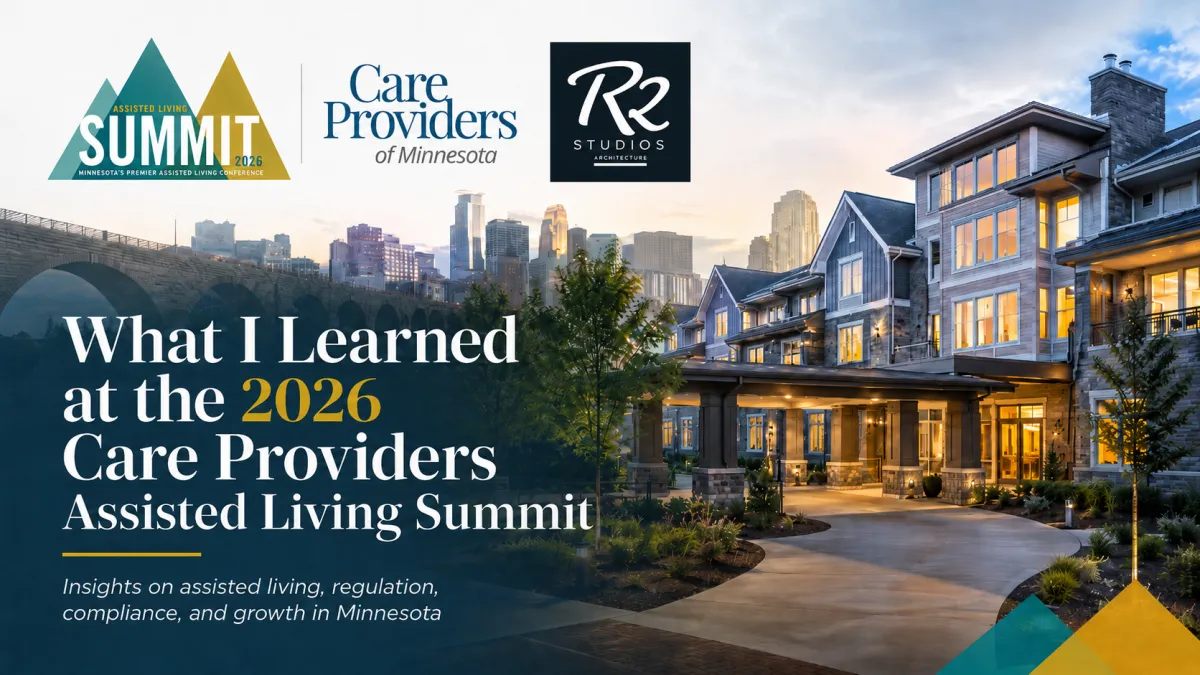
What I Learned at the 2026 Care Providers Assisted Living Summit
Industry Insights · May 27, 2026 · Zach Rynders
I spent two days last week at the Care Providers Assisted Living Summit in Minnesota. Eight sessions, a lot of caffeine, and more than a few conversations that stuck with me on the drive home. Here is what I walked away thinking about.
The Supply Crisis Is Not Coming. It Is Already Here.
LaShawn Pettaway from the National Center for Assisted Living laid out the numbers, and they are sobering. Right now, to maintain 90% occupancy through 2030, the country needs about 550,000 more assisted living units than currently exist. We are projected to build roughly 150,000 by then, and even that number is shrinking because of inflation and construction costs. The vast majority of what is being built is luxury or ultra-luxury, which does nothing for the affordable and middle-market residents who represent most of the demand.
Minnesota is not insulated from this. The state skewed heavily toward closing skilled nursing beds over the past decade, which made sense at the time, but it means there is no buffer. By 2034, four million more Americans will turn 85. By 2050, Minnesota alone is projecting 91% growth in the 85-plus population. If you are running a facility right now and wondering why your waitlist keeps growing, this is why. And it is going to get harder before it gets easier.
Policy Watch When access becomes a visible crisis, policymakers reach for solutions. Some of those — like rate caps on private-pay assisted living — would be devastating to the model. The message from the summit was clear: operators need to be talking to their legislators now, not when the bill is already on the floor.
Regulation Is Piling Up, and Most Operators Are Not Ready for It
Care Providers of Minnesota President Toby Pearson filled in for a no-show DHS presenter and delivered one of the most direct talks of the conference. His message: the legislative session that just ended was not the problem. It is the preview.
Up until the final hours of the session, there were serious pushes for mandatory staffing ratios in assisted living, rent increase caps, expanded county inspection authority over small providers, and something called an "assisted living workforce standards board" that would effectively let an unelected board dictate compensation and benefits at every licensed facility in the state. None of those passed, but none of them went away either. They will be back.
The fraud conversation is also changing. Legislators are using the word broadly, and some of what they are calling fraud — like not charging rent to a resident who cannot pay it while still providing care — is something many good operators do out of genuine concern for their residents. If you are doing anything like that without documentation, you are exposed. Toby's advice was blunt: know your local legislator by name, invite them to job shadow at your facility, and make sure they understand what actually happens in your building before someone else tells them a different story.
Physical Environment Compliance Is a Business Risk, Not Just a Regulatory Chore
Michael Mural, a former Minnesota Department of Health architect who now runs his own consulting firm, gave the most operationally relevant session I attended. His core point: most assisted living operators treat physical environment compliance as a late-stage problem, and that is exactly backwards.
He walked through case after case where operators purchased buildings, started design processes, or kicked off renovations without understanding their regulatory story. The costs were not small. One project faced a 12-month delay and $10 million in cost overruns because the architect did not understand MDH's requirements. A smaller outstate renovation cost the operator $1.4 million in delays because they did not submit to the Department of Health before starting construction, not knowing they were required to.
Key RiskIf your facility converted from a housing-with-services license to the new assisted living license in 2021, your building is classified as existing non-conforming. That means any project you do — including some that feel like simple maintenance or cosmetic updates — can trigger compliance reviews that were never on your radar. Going from 15 residents to 16 changes your physical plant requirements significantly. Adding a memory care license changes them dramatically.
AI Data Is Not the Risk. Unstructured Data Is.
The afternoon session on responsible AI use in senior care brought together a healthcare attorney, a data analytics company, and a Director of Innovation from a Minnesota care provider. The panel's most useful insight was counterintuitive: having more data does not increase your liability. Having data that is unstructured and unreviewed does.
The attorneys and operators on the panel talked about AI tools that can predict fall risk with 75% accuracy by reading resident records and identifying patterns before clinical staff would catch them. That kind of tool is genuinely useful. But the legal and operational risk comes when operators look at that data, see a red flag, and then do nothing with it. Once you know something, you are expected to act on it.
The recommendation was to build a formal Quality Assurance process — even though it is not yet required in assisted living — and run your AI data analysis through that structure. Data reviewed under a properly constituted QA program has legal protection. It generally cannot be handed over to surveyors or plaintiffs' attorneys. Data that floats through your Teams chats and email threads does not have that protection. The panel's advice was not to be afraid of what AI shows you. Structure how you see it so that you can act on it and be protected when you do.
The Waiver System Rewards the Operators Who Know It Best
Two separate sessions covered waivered services and customized living in detail. The practical takeaway from both is that most operators are leaving money on the table — not through fraud or negligence, but through incomplete documentation and a poor understanding of how case mix classification works.
Your case mix determines your daily rate cap. If a resident is classified at a case mix that does not reflect the care you are actually providing, you are providing services you are not getting paid for. The assessors who set those classifications do not always capture the full picture, partly because residents often understate their own needs when asked directly, and partly because providers are not in the room during the assessment. The way to protect yourself is to have detailed, accurate service plans and to provide that documentation to the assessor proactively before they complete their assessment.
A few practical things worth noting: submit documents through the MnBenefits portal rather than email, so you have a confirmation record if a case manager changes or misplaces your paperwork. Push back when a case manager says a resident is "capped" and cannot be reassessed — the law gives you the right to request a change-in-condition assessment within 20 days. Document socialization and mental health management time in the customized living tool, which many providers skip entirely even though it is a reimbursable service component.
The relationship with your case manager matters as much as the paperwork. The operators who are getting what they are owed are the ones who treat case managers as partners, communicate proactively about changes in resident condition, and push back professionally when something does not add up.
What tied all of this together, across every session, was a simple reality: the operators who are going to do well in the next decade are the ones who are paying close attention to the regulatory and policy environment, staying proactive on compliance, and building systems that let them document and defend the care they are already providing. The ones who are not paying attention are going to be surprised. Repeatedly.
Want to talk through what this means for your facility?
Whether you are operating, looking to buy, or planning to build — we are happy to have that conversation.
About the Author
Zach Rynders is the Director of Operations at R2 Studios Architecture and a licensed real estate agent with Real Broker. He focuses on assisted living development, renovation, and real estate transactions in Minnesota.
